HRH Emir of the Eastern Region, and Sumou Holding Chairman at the Endowment Practices Forum launch
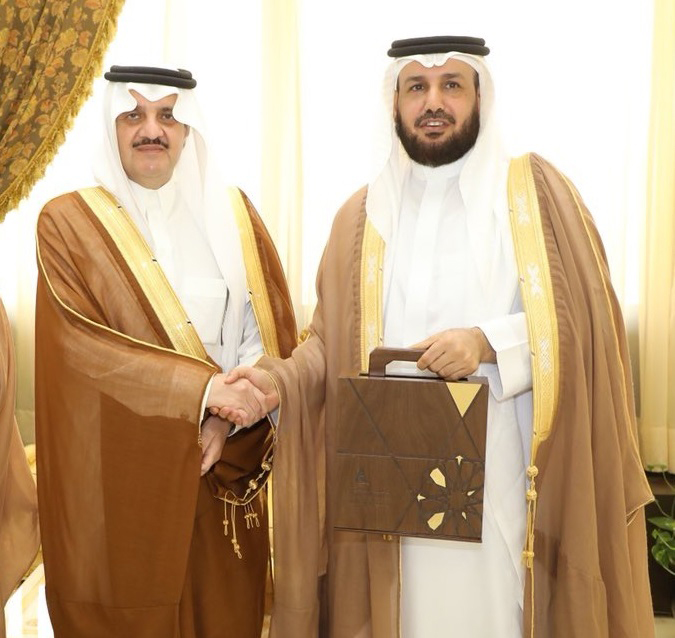
Under the patronage of His Royal Highness Prince Saud Bin Nayef Bin Abdulaziz, Emir of the Eastern Region, His Royal Highness Prince Ahmed Bin Fahd Bin Salman, Deputy Emir of the Region, opened on Sunday the activities of the Endowment Practices Forum 2018 organized by the Chamber of Oriental Affairs represented by the Endowments Committee. This was in the intensive attendance of government officials, businesspersons and many experts and specialists from inside and outside the Kingdom.
“Our country today is heading towards a new era of a flourish and diversified economy according to a pioneering vision that emphasizes the importance of the private sector and the roles it can play in building a competitive endowment sector. This is through either transferring the administrative expertise thereto or establishing new endowments that will serve as an extension of the national economy and cover a wide range of the needs of society. Through endowment, religious, educational and therapeutic care projects of various kinds are established”, said Abdul Hakeem Al Khalidy, Chairman of the Eastern Region Chamber, in his speech in the opening ceremony.
Al Khalidy added that despite the growing interest of our wise government, public and private sector institutions as well as charitable endowments, the Eastern Region Chamber has early harnessed its potential to participate in the revival and development of endowment among the business community. It proceeded to spreading awareness of the importance to establish endowments and adopt endowment practices among the business sector in the Region. It also coordinated with various official and non-official bodies to develop the laws and regulations governing endowment projects.
He pointed out that the good management of endowment assets is still in need of more ideas about the legislation, increasing their volume and diversifying their trends and banks, so that we achieve our goal of sustainable growth and the significant participation of the sector in the gross domestic product by 2030.
Al Khalidy referred to that this forum, with the papers it provides and the issues it brings up to discuss the practical aspect of how to upgrade the practices of local endowments and increase their effectiveness and impact on the national economy, is a platform for communication and knowledge development for successful endowment practices locally and externally. These are in addition to the understanding of development, investment and legal issues of the endowment system, in response to the developmental endeavors of our wise government and the unremitting social movement to increase the economic and social endowment contributions.
At the end of his speech, Al Khalidy appreciated the great efforts exerted by the State to upgrade the endowment system in accordance with contemporary scientific foundations. He expressed the hope that this forum, with the ideas introduced as well as the endowment experiences and practices discussed therein, will contribute to the development of endowments and reaching new ideas to manage their assets and encourage their establishment among the business community because of their impact on business and family inheritance.
For his part, the Chairman of the Endowments Committee in the Eastern Chamber, Dr. Ayedh Al Qahtany, said, “As a pride of Islam and a living witness to the development of Islamic civilization, endowment has become one of the most important aspects of the developmental contributions that underpin the rules of sustainable development in modern era”.
Al Qahtany pointed out that our homeland in the era of the Custodian of the Two Holy Mosques King Salman Bin Abdul Aziz and the Crown Prince His Royal Highness Prince Mohammed Bin Salman Bin Abdul Aziz is witnessing a great interest and extensive mobility towards the rediscovery of the endowment sector by addressing its operational, organizational and legislative challenges. This is for endowment to be a pillar of the national income, where the contribution of the non-profit sector, for which endowment is the backbone and the main source of funding, is only (0.3%) of the Kingdom’s gross domestic product compared to the global average of (6%). In addition, the public endowment percentage amount to (325) million Saudi Riyals annually compared to the volume of the public endowments under the administration of the General Authority for Endowment, which is estimated at (14) billion Saudi Riyals. In both cases, these are weak percentages in comparison to the volume of the Saudi economy and the large potential available therein.
Al Qahtany said that the future of the endowment sector in the Kingdom is promising, where there is significant good energy in the Saudi society as well as a political will aimed at upgrading the endowment sector, thus reaching a diversified sector of banks that is capable of achieving the desired effect in the national economy. Hence, the importance of this forum is represented in seeking to shed light on various aspects of upgrading the endowment sector in the Kingdom and exploring its roles and future in accordance with the best endowment practices in light of the requirements of the current economic development.
At the end of the official ceremony, the Chairman of the Chamber, Abdul Hakeem Al Khalidy, honored to present a commemorative gift to the Emir of the Eastern Region for his sponsorship for the Forum. He also honored to present a commemorative gift to His Highness the Deputy Emir of the Eastern Region for attending the ceremony. In addition, the Chairman of the Endowments Committee, Dr. Ayedh Al Qahtany, presented a commemorative gift to His Highness the Deputy Emir of the Eastern Region as well as a set of Commission’s publications.
The Forum witnessed holding six sessions of extensive dialogue, during which a number of local and external endowment experiences were presented. They also witnessed extensive dialogue processes.
FIRST SESSION
Dr. Robert Graf Stratsweter, CEO of Misana Foundation in Germany, said that the endowment status is a common status between nations and peoples. It is a common human heritage and the responsibility seems to be similar among institutions as a tool of charitable work. He called for more cooperation between charitable institutions wherever they work.
In the session titled “Endowment Experience between Europe and the Arab World” and managed by Eng. Salah Al Zamel, Board Member of King Abdul Aziz & His Companions for Giftedness & Creativity (MAWHIBA), he added that the Islamic endowment or the asset in Islamic Shari’ah is not far away in its practical form from some institutions in Germany, France, Netherlands and Italy. The foundations are almost the same and the goals are close.
At the end of his paper, he described charities as a source of creativity in work, activity and ideas.
SECOND SESSION
David Russell, Legal Counsel at Otter Temple Legal and Tax Consultancy Offices, emphasized that a legal framework for endowments should be found to avoid family disputes and to ensure continuity of performance in a sustainable structure.
In the second session held under “Successful experiences in Family Endowments Governance” and managed by Eng. Mohammed Arab, CEO of the Sulaymaniyah Investment Group and Member of the National Endowments Committee, he said, “Over (70%) of family businesses in the Arabian Gulf do not last for the third generation, unlike many other western countries. Here, wealth comes from public companies and even endowments in many countries last for lifetime. In the United States, for example, endowments are divided between health and others. In order to prevent the severe abuse of endowments that take place in some countries, there must be a stable system of property through the institutionalization of governance as appropriate for family needs”.
THIRD SESSION
Dr. Fahd Al Deilij, CEO of Saad Abdul Aziz Al Mousa Endowment, highlighted the experience of Saad Abdul Aziz Al Mousa Endowment. This local endowment experience managed to achieve, according to Al Deilij, growth and sustainability and to obtain the Rubeiz Quality Certificate, which is the Arabic version of the British CES Organization’s Picasso System. This is according to the vision developed by Sheikh Saad and Sheikh Abdul Aziz Al Mousa based on the active contribution to building an advanced charitable sector that participates in achieving sustainable development.
FOURTH SESSION
Khalid Qamah, CEO of Methaq Holding Company, discussed the experience of Ibn Mahfouz Endowment as well as the institutional investment of endowment assets and its main components through this experience in terms of its international and local portfolio. He pointed out that the purpose for endowment investment is to protect, develop and sustain it at the long term and to find a balance in the market as a result of the competition arising from new offers under the limited growth of demand. He also mentioned that Ibn Mahfouz endowments are an investment practice since 1998. Throughout this period, such endowments achieved a good success and have become an investment endowment entity comparable to the international experiences, due to adopting the institutional frameworks in their endowment assets. He stressed that an important aspect of institutional management is to follow the surrounding developments.