Sumou Suburb accommodates 25 thousand persons
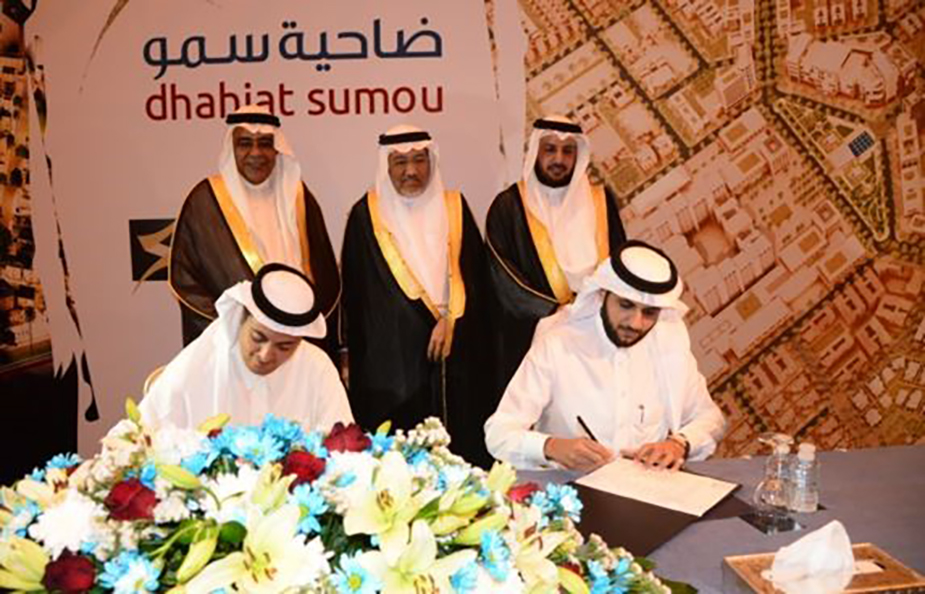
By cost over SAR 3 billionDr. Ayed Al Qahtani, Chairman of Sumou Suburb, said that the superstructure of the suburb located within Mecca Gate project are expected to commence during the coming year 2015, noting that at the late 2014, the project will witness completion of large portion of infrastructure works that will go in line with signature of the agreement on superstructure works.
He indicated that the project will complete the infrastructure works after about one year and half from the time, while the superstructure works will be completed within two years and a half, noting that the project will be developed to become international project with authentic local Mecca style.
Al Qahtani was talking during the dinner party held on the occasion of signature of agreement contract of the infrastructure works signed by Abdullah Al Qahtani, General Manager of Sumou Company with Al Bassamy Contracting Company, noting that the Suburb Project is a live example of the Public Private Partnership in the urban development projects in KSA.
He noted that the project of the suburb 13 km from Al Masjid Al Haram is one of the projects of housing districts in the entrance of the Holy Mecca, as the project area is about 1.6 million square meters, and the total built area exceeds 1.5 million square meters and can accommodate 25 thousand person for total cost of the project that exceeds three billion riyals.
“In Sumou Suburb Company, we will build 40 % of the project, and the remaining 60% of the project will be completed by tender before the developers of investors and developers of individuals”, adding that “We don’t need to retain any undeveloped land in the project to complete the beauty of the city, and we will cooperate with them on the procedures of licenses and requirements for starting their works”, he said, adding that the Suburb project has come within the framework of the development plans and for meeting the housing need that the rational leadership aspires to meet. Believing in the role of the sector to participate, the Holy Capital Secretariat, jointly with Mecca Gate Company, worked on adoption of the planning methodologies and concepts provided by Sumou Company, to satisfy a key part of the requirements of modern development of the Holy Mecca residents and visitors with advanced level of quality, design efficiency and level that can match Allah’s inviolable country and employ the modern development concepts, principles and sustainability and rationalization of resources as well as achieving prosperity of living and economic welfare.
Concerning the idea of the project, the Chairman of Sumou Suburb said: “the project contains plan of the Mecca Gate, parallel to the mode of the gate, and it is the main entrance to Mecca, and directly overlooks the Mecca- Jeddah Highway, with area of more than 1.6 million m2”
He noted that the Plan of Mecca Gate presented flexible organizational framework of vast area that exceeds 83 km2 in area, to constitute a western province of the Holy Mecca City independent with its service and close to the city center, to alleviate the demographic decentralization it. The area enjoys high efficiency of planning, quality of urbanization and modernity of utilities and services in the way that matches and prides the place, and employs its privileges for the service of Mecca and Al Bait Al Haram and the general province.
Al Qahtani believes that the project of suburb embodies a modern contemporary model of the projects with high standards of quality, from site planning, through designs of infrastructure and buildings and green areas, to the technical standards to be applied during the different phases of project development.
He noted that going into several key details during the phase of preliminary planning of Sumou Suburb, deriving from the desire to present several advantages of the planning strategy based on the principle of integrating services with the urban cordon that secures easy movement between residential and commercial areas and the basic multiple services in the suburb through modern network of wide multi-outlet roads and streets.
Al Qahtani noted that all parts of the project have strategic facades that contribute to promote several patterns of movement and transfer, to balance the requirements of dense traffic movement and the requirements of security and privacy, requirements of pedestrian movement, to provide practical system of traffic movement in the urban cordon of the project and outside it at the meantime.
The planning thought Sumou Suburb reflects the key objective of its presentation, to provide exemplary model of the standards of smart planning of modern cities by presenting components of the main and distinguished needs of the residents of the project through multipurpose utilities, and the communities and retail stores, sanitary services and mosques. In addition, the project didn’t ignore the basic educational and entertainment services so it has met the most important and development international standards of planning.
The suburb is divided into two adjacent housing areas, separated by main pivot perpendicular with the Mecca- Jeddah Highway parallel to the suburb that collects the key multi-service to provide the maximum convenience and service to residents. This corridor is connected by the gate model on the highway, the mall and hotel at its end, and graded vein roads come out of it to extend in curves to allow the extension of facades overlooking these roads, and to impart urban diversity on the residential units to combine all components of the optimum residential community.
The project aims at establishing developed housing environment with integrated services at developed style and unique flexibility to safeguard quietness and convenience and to match and go in line with an architectural pattern that generates strong sense of place and express the urban identify of the holy adjacent area while keeping the cultural traditions of Saudi Arabia and the social climate that matches the valuable traditions of society. Architectural designs of residences and buildings are inspired from the architectural identity of the Old Mecca. This was reflected on the utilization of the original Hegazi style on the windows and sides of the units, to add the aesthetic side with distinctive and unique style. In addition, the project observed the privacy of residential units that distinguish the Islamic architecture from the remaining types of architecture thro